Digital Product Bundle or Individual Sales: How to Decide
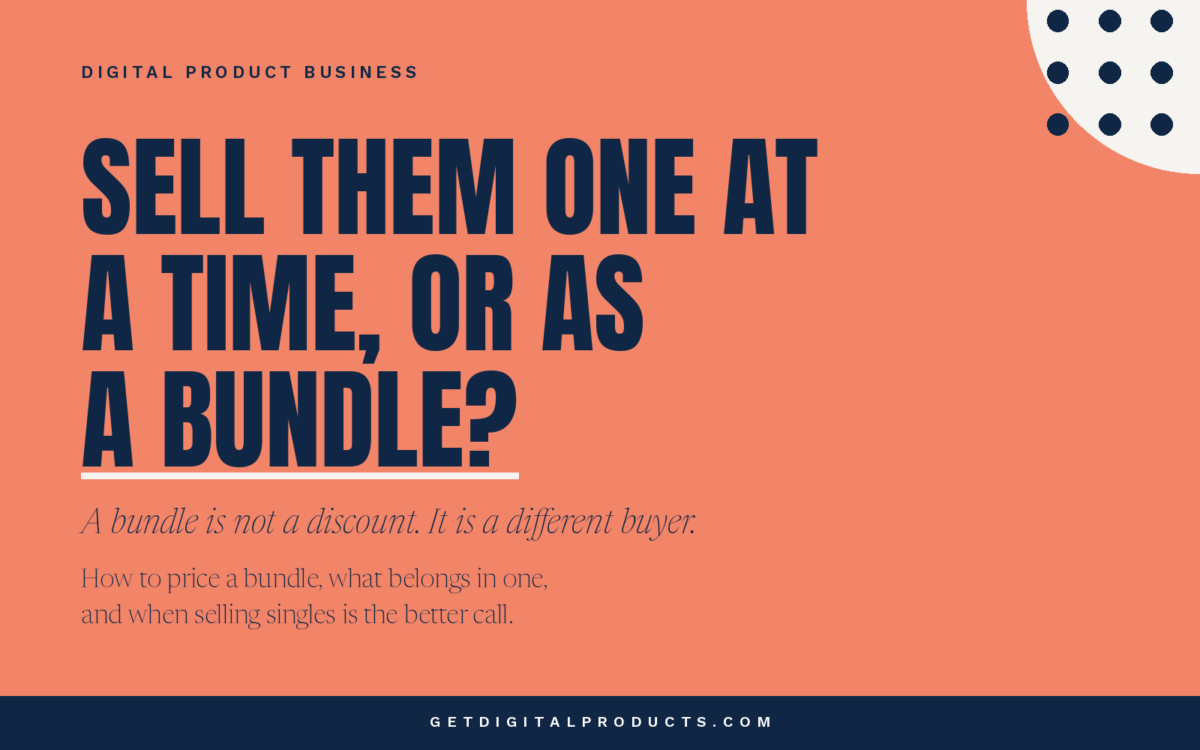
Short answer: do both, and stop thinking of a digital product bundle as a discount. A bundle priced as “the same products, cheaper” trains people to wait for the discount and quietly devalues everything you sell individually. A bundle priced as a different offer, for a different buyer, does the opposite.
Here is how to think about the difference, how to price one, what belongs inside it, and when selling singles alone is the better call.
Two buyers, not one
The reason to offer both is that two genuinely different people arrive at your shop.
The first has one specific problem. They need a content calendar, or a pricing worksheet, or a brand checklist, and they need it today. Offer them a bundle, and you have raised the price of solving their actual problem by a factor of two. Many will leave.
The second has the whole problem. They are starting a brand from nothing, or building a content system from nothing, and they do not yet know which piece they need because they do not know what the pieces are. To this person, a list of individual products is work. They have to evaluate each one, guess which ones matter, and assemble something. A bundle does that thinking for them, and the price is not the obstacle — the decision is.
Sell only singles, and you lose the second buyer. Sell only bundles, and you lose the first. The catalog is not the offer. The packaging is.
Why a digital product bundle is not the sum of its parts
The instinct is to add up the individual prices and knock something off. Five products at $15 each become $75, minus a bit; call it $59. This is the wrong model, and it produces prices nobody pays.
Think about what the buyer is actually comparing. They are not comparing your bundle to the sum of your singles. They are comparing it to the price of not solving the problem, and to the one or two other things they might buy instead. A $59 bundle sits in a different mental category from a $34 one, no matter how the arithmetic works out.
For a shop selling focused, inexpensive files, a bundle in the low thirties does something specific: it stays inside the range where buying is still a small decision. That matters more than the nominal saving. A buyer who would think hard about $59 will often buy $34 without deliberating, and the second outcome is worth more than the margin you gave up.
To put real numbers on it, here is how this shop is priced. Individual products sit at $14.95 to $15. Bundles sit at $33 to $34. That is a ratio of roughly 2.2 to 1 — a bundle costs a little over twice a single, regardless of how many files are inside it.
That ratio is the decision, and it was not arrived at by adding anything up. It was chosen because both numbers had to stay in the range where nobody has to think very hard. Fifteen dollars is a lunch. Thirty-four is a decision you make in one breath. The moment a bundle crosses into the range where someone opens a second tab to compare, the packaging has stopped doing its job.
There is a second effect worth knowing about. Prices are read relative to each other, not in isolation. A bundle at roughly twice the price of a single makes the single look like a modest, sensible purchase — and makes the bundle look generous rather than expensive. Each price makes the other easier to say yes to. Set the bundle at four or five times the single and that relationship breaks; now the single looks like the only reasonable option and the bundle looks like an upsell.
What actually belongs in a bundle
The most common mistake is bundling by category. “Here are all seven brand products” is not an offer. It is a filing system, and the buyer can already see it on your category page.
A bundle should solve one complete problem, start to finish. The test is whether you can describe what the buyer will have finished by the end of it in a single sentence. “Everything in the content category” fails that test. “A month of content planned, written and scheduled” passes it.
That framing also tells you what to leave out. If a product does not contribute to the finished outcome, it does not belong in the bundle, even if it sits in the same category and even if including it would make the value look better on paper. Padding a bundle with loosely related files is visible to buyers. It makes the whole thing feel like inventory clearance.
Three to five products is usually the right size. Fewer and it is not obviously a bundle. More and the buyer stops believing they will use all of it, which undercuts the reason they were willing to pay for the set.
When not to bundle
A few situations where singles are the better answer.
- Your best product would carry weak ones. If one file is doing all the work and the others are filler, a bundle borrows credibility from the strong product and spends it on the weak ones. Fix the weak products or leave them out.
- The products do not sequence. Some things genuinely are standalone. Forcing them into a set produces a bundle with no story, and a bundle with no story is just a discount.
- You have too few products. With a small catalog, every bundle cannibalizes a meaningful share of your single sales. Bundles work better once the catalog is deep enough that most buyers were never going to buy all of those files separately anyway.
- You would have to discount steeply to make it look worthwhile. If a bundle only makes sense at 70% off, the individual prices are probably what need examining.
How many bundles
Fewer than you think. Each additional bundle adds a decision to the buyer’s path, and decisions are where people leave.
A small number of bundles, each mapped to a complete outcome, works better than one bundle per category. If a visitor has to compare four bundles to work out which one contains the thing they came for, you have rebuilt the problem the bundle was meant to solve.
A reasonable structure for a shop of a few dozen products: individual files for the person who knows what they want, a handful of outcome-shaped bundles for the person who does not, and nothing else. Resist the urge to add a bundle every time you publish something new.
Pricing checklist
When you set the number, work through these in order.
Start from the buyer’s alternative, not your catalog. What else would this person spend the money on, and what would it cost them not to solve the problem? That sets the ceiling far better than adding up your own prices.
Stay inside the impulse range if your singles are inexpensive. A shop built on focused, affordable files should not have a bundle that requires deliberation. The whole proposition is that buying is easy.
Keep the ratio sane. Roughly two to two and a half times a single price keeps both offers looking reasonable side by side. The example above sits at 2.2 to 1.
Do not stack discounts on the discount. If the bundle is already the better deal, running a sale on it tells buyers the real price was never real.
Write the outcome, not the contents. The product page should lead with what the buyer will have finished, and list the files second. Most bundle pages do this backward.
Frequently asked questions
Should a digital product bundle always be cheaper than buying the products separately?
Yes, or there is no reason to choose it but the size of the gap matters less than most people assume. The bundle wins because it removes a decision, not because it saves the maximum possible amount.
Will bundles cannibalize my individual sales?
Some, yes. The question is whether the buyers taking the bundle would otherwise have bought one product or several. If most of them would have bought one, the bundle is raising your average order value rather than cutting it.
How many products should be in a digital product bundle?
Usually three to five. Enough to feel like a complete solution, few enough that the buyer believes they will actually use it.
Should I bundle by category?
No. Bundle by outcome. A category is how you organize a shop; an outcome is what a buyer is trying to reach.
Can I put a new product into an existing bundle later?
You can, and it is a reasonable way to add value for past buyers if you give them the addition. Just make sure it belongs in the outcome rather than being added because it is new.
The short version
Offer both. Price the digital product bundle as its own offer rather than as a pile of discounted singles. Build each one around a finished outcome you can name in a sentence, keep it to three to five products, and keep the number of bundles small enough that choosing between them is not itself a chore.
If you are still working out what a digital product is and how the delivery side works, start with What Exactly Are Digital Products? — and if you want to see how the ideas here play out in practice, the bundles in our shop are built on exactly this reasoning.