How to Get Cited by AI Search: Write Passages, Not Pages
To get cited by AI search, put your answer in the first two sentences of every section and make each section make sense on its own. Answer engines don’t retrieve your page. They retrieve a chunk of it, and that chunk has to work with nothing around it.
That is the whole idea behind everything below, and it changes how you write more than it sounds like it should. Here is what it looks like in practice, including rewrites, and three limits worth understanding before you spend a weekend restructuring anything.
What is an answer engine?
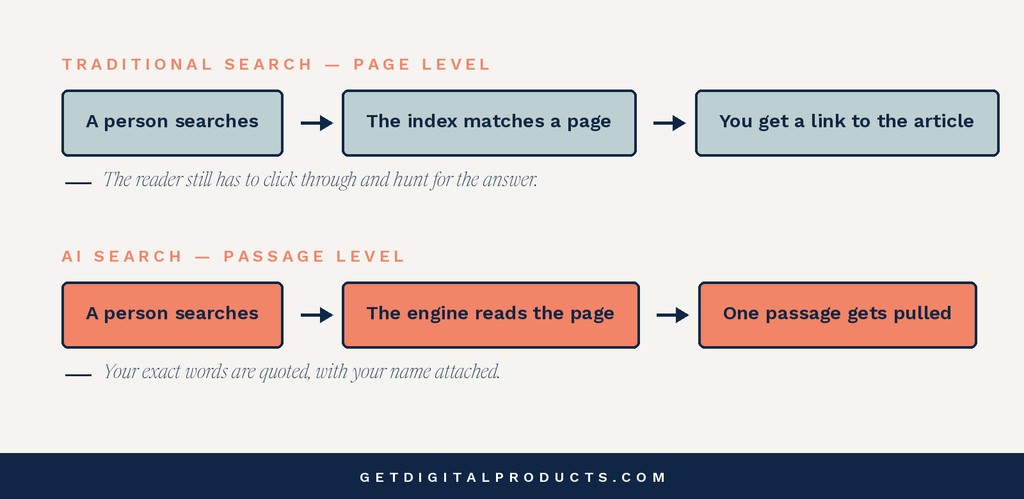
An answer engine is an AI system, such as Perplexity, ChatGPT, or Google’s AI Mode, that returns a direct, synthesized answer to a question rather than a list of links. A traditional search engine behaves like a librarian pointing you toward a book. An answer engine behaves like a research assistant who reads the pages, summarizes what matters, and names the sources it used.
Optimizing for those systems is usually called Answer Engine Optimization, or AEO. The goal is not to rank a page. The goal is to write a passage clean enough that an answer engine picks it up and attributes it to you.
Why the unit of competition is the passage
When someone asks ChatGPT, Perplexity, or Google’s AI Mode a question, the system searches for relevant material, pulls specific passages, and builds an answer from them. It isn’t reading your article the way a person does. It pulls two or three paragraphs and decides whether they answer the question.
So a page can be excellent and never get cited, because its good parts only make sense in context. A modest page can get cited constantly, because one section of it answers a question cleanly and completely on its own.
This is why the old instinct to build toward a conclusion works against you. An article that spends four paragraphs setting up before delivering the point has buried the retrievable part under material that reads, to a retrieval system, like a preamble.
Lead with the answer, then explain
Open every section with a direct sentence that states the point, then support it. This inversion feels abrupt if you were taught to write essays, and it is the single highest-value change you can make.
| Weak | Pricing digital products is something many creators struggle with. There are a lot of factors involved, and what works for one shop may not work for another. Over the years, a number of approaches have emerged. | Not retrievable. The paragraph contains no extractable answer. |
| Strong | Price a bundle at roughly twice the price of a single product, not the sum of its parts. A bundle competes with the buyer’s alternatives, not with your own catalog. | Highly retrievable. The passage can be lifted whole and still answer the question. |
The second version survives on its own. The first says nothing a system could quote, because it hasn’t said anything yet.
A useful test: read your opening sentence alone, with no heading and no paragraph after it. Does it answer something? If it only sets up an answer, rewrite it.
How to make sections survive on their own
Retrieval strips context away. Phrases like “as we saw above,” “this approach,” and “the second option” break a passage the moment it travels, because the thing they point at is no longer there.
The fix is to restate rather than refer. Instead of “this is why the second method works better,” write “outcome-based bundles work better than category-based ones because.” It reads slightly more repetitive to someone going straight through, and it reads correctly to everyone else, including the person who landed on your page from a search and scrolled to the middle.
Headings do the same job. “Why a digital product bundle is not the sum of its parts” tells a retrieval system what the section contains. “Going deeper” tells it nothing.
Keep paragraphs short and formats consistent
Three or four sentences is a reasonable ceiling. Long blocks force a system to summarize rather than quote, and a summary doesn’t carry your name with it.
Consistency matters more than people expect. Mixing heading levels arbitrarily, switching between bulleted and numbered lists for the same kind of content, and varying paragraph length wildly all make a page harder to parse cleanly. The structure should be boring and predictable.
Lists, comparison tables, and short definitions are especially retrievable, because they are already chunked. A definition sitting in its own two-sentence paragraph is far more liftable than the same definition buried mid-paragraph.
Why unique substance beats clean formatting
Structure decides whether you can be quoted. Substance decides whether you’re worth quoting.
If you restructure a page that has nothing specific to say, you get well-shaped emptiness. Every competing article on your topic also says “consider your audience” and “focus on quality,” so a retrieval system choosing between eight pages that all say the same thing has no reason to choose yours, however tidy your headings are.
What gets chosen is the page with something checkable in it. A number you measured, a method you actually use, a price you actually charge, or a named example with a date attached. Specifics are quotable in a way that generalities never are, because a generality can be rephrased from the model’s own training data, whereas a specific fact has to be attributed to someone.
This is the uncomfortable version of the advice. Formatting is the easy half, and it’s the half everyone writes about. The hard half is having something to say that nobody else has said.
Limitations of answer engine optimization
Three honest limits.
It isn’t a guarantee. Answer engines are probabilistic. The same question asked twice can return different sources. Good structure shifts your odds; it doesn’t buy you a slot, and any tool promising otherwise is overreaching.
It isn’t permanent. Models get updated, competitors restructure, and the queries that ground an answer shift over time. A citation is a position you keep working at, not a badge you earn once.
It isn’t separate from ordinary SEO. Google’s documentation on AI features states plainly that there are no special requirements or optimizations for appearing in AI Overviews or AI Mode. The same fundamentals apply. If a crawler can’t reach your page, or your content assembles itself with JavaScript after load, none of the rest matters.
A quick pre-publishing checklist
Run through these five before you publish.
- Does each section’s first sentence answer something on its own?
- Does each heading describe what is in the section, in words a person would search?
- Have you removed every “as mentioned above” and “this approach”?
- Is there at least one specific, checkable fact that only exists on your page?
- Are paragraphs under four sentences, with consistent formatting throughout?
Frequently asked questions
How long should a passage be to get cited by AI search?
Roughly one to three short paragraphs, forming a complete answer to one question. Long enough to be useful, short enough to lift whole.
Do I need schema markup to get cited by AI search?
It helps systems understand what your content is, and FAQ and article schema are worth adding. It is not a substitute for a clearly written answer, and it will not rescue a page that buries its point.
Does this mean I should stop writing introductions?
No, but keep them short and put the answer inside them. An introduction that delays the point for four paragraphs costs you both readers and citations.
Is writing for AI search different from writing for people?
Less than you would think. Answer first, clear headings, short paragraphs, and specific claims all describe good writing for someone skimming on a phone. Retrieval systems happen to want the same things.
How do I know if it is working?
Ask the engines questions your content should answer, and see what they cite. It is manual and imperfect, but it is free and, at a small scale, it tells you more than most tools will.
The short version
Write so that any single section of your page could be lifted out, quoted alone, and still answer a question completely. Lead with the answer, restate instead of referring back, keep paragraphs short, and make sure there is something specific on the page that nobody else can say.
Structure gets you eligible. Substance gets you chosen.
For the wider picture of how AI search reads a site, start with AEO and GEO Explained. And if you have been told an llms.txt file will get you cited, we looked at the evidence.